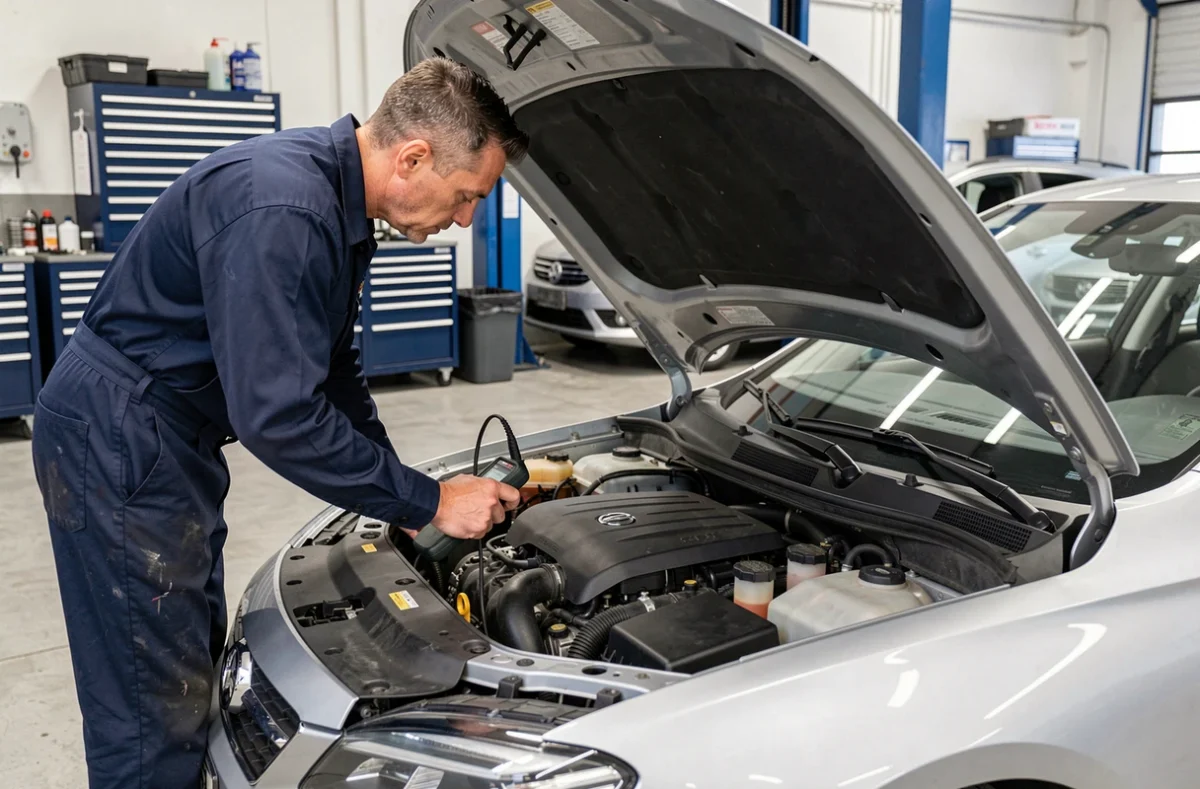
When a driver looks for a garage, they rarely compare services item by item. The range of services offered by Armoric Auto covers a wide spectrum, from routine maintenance to heavy mechanical repairs, including electronic diagnostics. Reviewing these services allows one to measure what distinguishes a general workshop from a simple oil change point.
Car maintenance and mechanical repair: what each intervention entails
The terms “maintenance” and “repair” are often used interchangeably. They refer to interventions of very different natures, with distinct implications for the vehicle’s longevity.
| Type of intervention | Indicative frequency | Main objective |
|---|---|---|
| Engine oil change | According to manufacturer recommendations | Protect the internal components of the engine |
| Full service | Annual or according to mileage | Check all wear points |
| Brake pad replacement | As soon as noise or dashboard alert appears | Maintain braking safety |
| Electronic diagnostics | At every engine light or anomaly | Identify a fault without disassembly |
| Air conditioning recharge | Every two to three years | Restore the performance of the cooling circuit |
| Brake fluid flush | According to maintenance log | Avoid loss of braking efficiency |
The full service generally includes checking fluid levels, inspecting belts, verifying lighting, and assessing tire condition. In contrast, an intervention like brake pad replacement falls under repair: it corrects a malfunction that has already been detected.
A garage capable of covering all these services prevents the vehicle owner from having to deal with multiple contacts. Combining maintenance and repair in the same workshop also reduces downtime.
Automotive diagnostics: why electronic reading changes the game
On a recent vehicle, most breakdowns generate a fault code recorded by the computer. Electronic diagnostics involves reading these codes, interpreting them, and cross-referencing the information with observed symptoms.
This step precedes any mechanical intervention when the engine light comes on. Without it, the mechanic works blindly and risks replacing parts unnecessarily. A precise diagnosis avoids unnecessary repairs and directly points to the faulty component.
The diagnostic tool is not limited to the engine. It also covers:
- The braking system (ABS, ESP) and the detection of faulty sensors
- The automatic or robotic transmission, whose error codes require dedicated software
- The air conditioning circuit, where a leak can be located by reading pressure and temperature
- Driver assistance systems (radar, rear camera) present on recent models
Not all garages have the same level of equipment. A workshop affiliated with a manufacturer network, like Peugeot Proximity, accesses the brand’s technical databases. An independent garage uses multi-brand diagnostic tools, which are more versatile but sometimes less comprehensive for certain engines.
Vehicle safety and pre-technical inspection
The technical inspection penalizes safety defects but does not correct them. The pre-inspection identifies refusal points before the official inspection, allowing anomalies to be addressed in advance and avoiding a re-inspection.
The most common reasons for refusal concern braking, lighting, steering, and emissions. A garage that offers pre-inspection will check these points according to the technical inspection grid, then provide a quote for the necessary corrections.
What the pre-inspection actually checks
The mechanic measures braking efficiency on each wheel, checks play in the ball joints and steering links, tests headlight alignment, and verifies tire condition (tread depth, asymmetric wear). On diesel vehicles, the opacity level of the exhaust is also tested.
Correcting a defect before the technical inspection generally costs less than undergoing a re-inspection within the imposed deadlines, as the pressure of the timeline sometimes forces acceptance of higher rates.
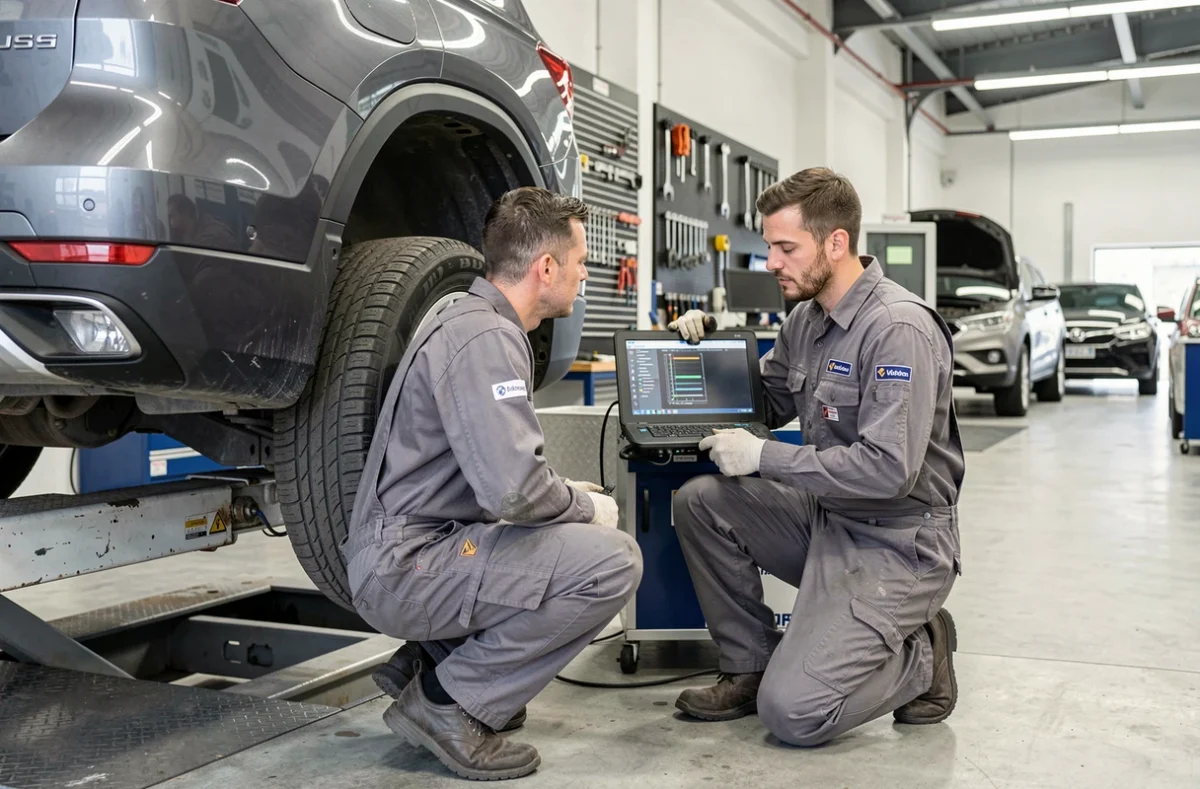
Online quotes and pricing transparency: what garages really display
The ability to obtain an online quote is an increasingly important criterion for drivers. Several brands in the AD network or affiliated dealerships offer this feature, but the level of detail varies significantly.
A relevant quote distinguishes the cost of parts, labor, and any additional fees (fluids, consumables). A transparent garage details each line of the quote rather than providing a global package without breakdown.
Comparing garages remains difficult if the quotes do not cover exactly the same scope. A service package that includes the replacement of the oil filter, air filter, and cabin filter does not hold the same value as a package limited to just the oil change. The reflex to adopt is to check the list of included operations before comparing amounts.
Service package or itemized billing
The package offers immediate clarity on the budget. Itemized billing adapts better to vehicles whose maintenance is partially up to date. A driver who has already replaced their filters does not need to pay for a full package.
The choice between a package and itemized billing depends on the vehicle’s maintenance history, not the displayed price. A cheaper package may include services already performed, which negates the apparent advantage.
The last point to check remains the warranty on parts and labor. A reputable garage specifies the warranty duration applicable to each intervention, which protects the customer in case of premature failure of a replaced part.